

Pickleball Court Dimensions: Official Specs, Layout & Setup Guide
Complete pickleball court dimensions guide: 20x44ft specs, net height, kitchen line rules, and setup for indoor/outdoor play. Learn from Sypik Champions.

Meta Description: Master official pickleball court dimensions — 20×44 ft specs, net height, kitchen rules, surface types & backyard setup guide per ITPF standards.
---
Understanding pickleball court dimensions is the foundation of every aspect of the game — from competitive tournament play to a backyard recreational setup. The standard court measures 20 feet wide by 44 feet long (6.1m × 13.4m), and every line, zone, and clearance measurement exists for a precise reason. Whether you're planning a facility build, converting a tennis court, or just want to understand the rules better, this complete guide covers every official specification you need.
---
Official Pickleball Court Dimensions at a Glance
The regulation pickleball court dimensions established by the International Pickleball Federation (ITPF) are unambiguous: 20 feet wide × 44 feet long (6.1 meters × 13.4 meters). This applies to all levels of competitive play — from recreational club matches to PPA Tour Asia and NGP Tour events. The total playing surface area is 880 square feet (81.7 square meters), making pickleball courts significantly more compact than tennis courts and ideal for indoor facility conversion and multi-court configurations.
These exact measurements are not arbitrary. The 44-foot length creates a balance between two distinct strategic zones: the 14-foot backcourt transition area and the critical 7-foot non-volley zone (the "kitchen") on each side of the net. The 20-foot width demands precision from sideline to sideline, keeping rallies focused without requiring the wide lateral coverage of tennis. Every inch of the court influences shot selection, positioning, and tactical decision-making.
The ITPF, which governs international standards including tournament certification across Asia, North America, and Europe, mandates these dimensions for all sanctioned competitions. USAPickleball.org enforces the same specifications domestically in the United States, ensuring that courts worldwide are interchangeable at the competitive level.
Recreational vs. regulation setups: Informal backyard courts sometimes deviate slightly from the official spec due to space constraints, but any deviation affects ball dynamics, positioning habits, and strategic development. Serious players — and every Sypik champion who competes at the regional and Asian level — train exclusively on regulation-dimension courts to ensure their muscle memory and court positioning transfer directly to tournament conditions.
---
Complete Court Layout & Line Markings Explained
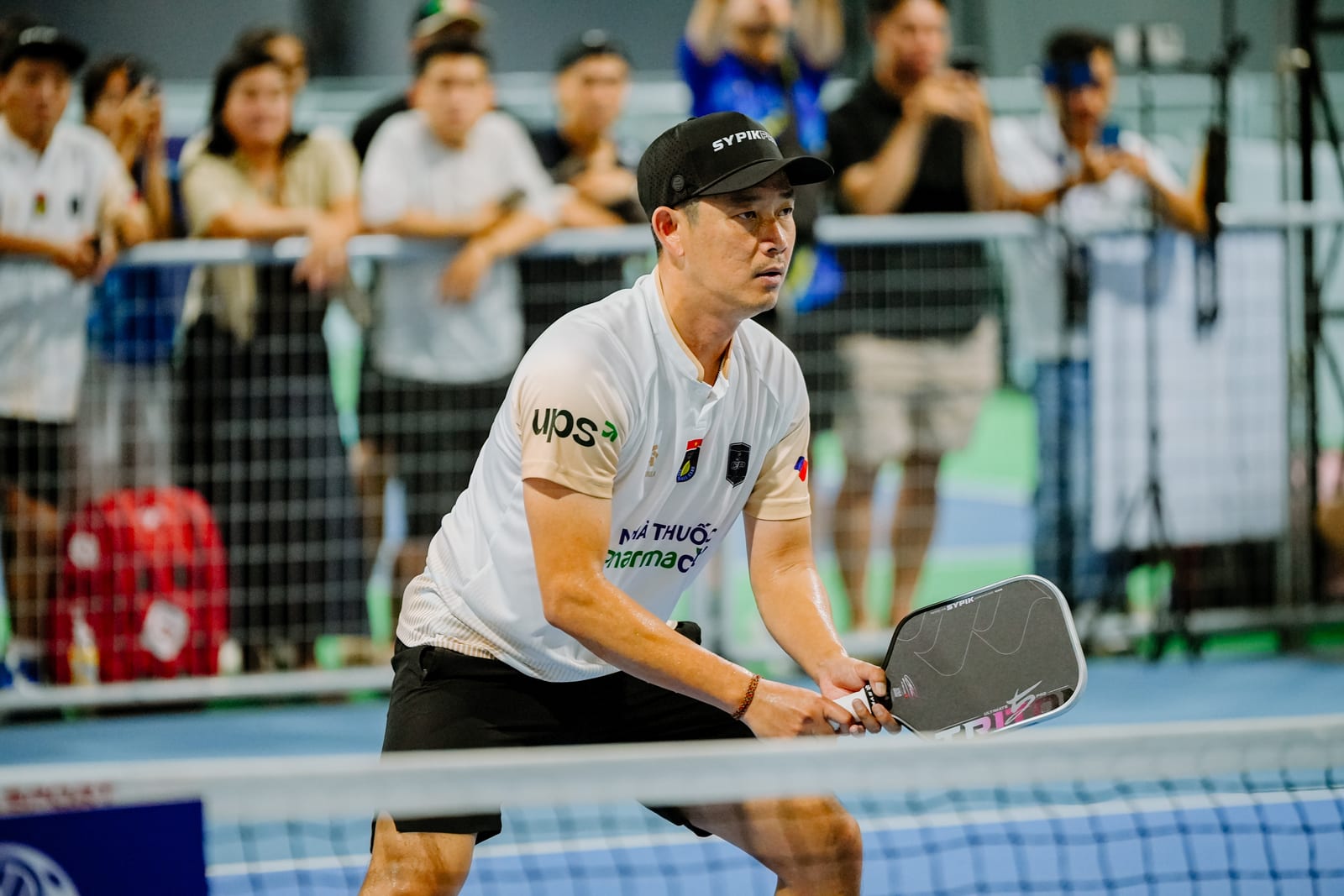 VĐV Sypik thi đấu pickleball
A regulation pickleball court is divided into precise zones, each with mandatory dimensions and marking specifications. Understanding the full pickleball court layout is essential for anyone building, marking, or coaching on a court.
Service Boxes: Each side of the court (divided by the net) contains two service boxes. Each service box is 10 feet wide × 15 feet deep, formed by the sidelines, the center service line, and the kitchen line. When serving, the ball must land in the diagonally opposite service box.
The Kitchen (Non-Volley Zone): The most strategically significant zone on the court. The kitchen extends 7 feet from the net on each side, running the full 20-foot width of the court. No player may volley (hit the ball in the air without letting it bounce) while standing within this zone or touching its lines. The kitchen line is the inside boundary of the non-volley zone — it is part of the kitchen itself, meaning a player standing on the kitchen line is still considered "in the kitchen" for volley purposes.
Baseline: The baseline runs across the full 20-foot width of the court and sits 22 feet from the net on each end. It marks the rear boundary of the playing area. Serves must be made from behind this line.
Sidelines: The sidelines run the full 44-foot length of the court, spaced 20 feet apart (10 feet on each side of the center axis). These mark the lateral boundaries of play for both singles and doubles.
Center Service Line: A line running from the kitchen line to the baseline down the center of each side of the court, dividing the service area into left and right service boxes. It does not extend into the kitchen zone.
Line Width and Color Standards: The ITPF recommends 2 inches (5 cm) as the standard line width for all court markings. Lines are typically painted or taped in white, though high-contrast colors (yellow or bright green) are sometimes used on darker surfaces to improve visibility. All lines are considered part of the court — a ball landing on any line is considered in play, except during the serve when a ball landing on the kitchen line is a fault.
Why the kitchen rule matters: The non-volley zone rule is the single most tactically defining element of pickleball. It prevents players from camping at the net and smashing everything. The 7-foot distance is calibrated to require players to dink (soft shots into the kitchen), reset rallies, and wait for attackable balls — creating the strategic depth that defines high-level pickleball.
---
Pickleball Net Height & Specifications
The pickleball net height follows a precise two-point specification that differs from tennis and most other net sports. At the sidelines, the net must measure exactly 36 inches (91.4 cm) in height. At the center of the court, the net sags to 34 inches (86.4 cm) — 2 inches lower than at the posts.
This differential is intentional. The lower center allows for a wider variety of crosscourt shots and dinks, while the higher sideline edges define the out-of-bounds trajectory reference for line calls.
Net construction requirements: The net must be made of mesh material fine enough that a ball cannot pass through it. Standard competitive nets are at least 21 feet 9 inches (6.6 meters) wide to fully span the 20-foot court with overlap at the posts. Net tension must be sufficient to maintain consistent height throughout a match — a sagging, undertensioned net at center creates an artificially advantaged crossing point that distorts competitive play.
Professional vs. casual net standards: Tournament-grade nets used on PPA Tour Asia and certified ITPF events are constructed from heavy-duty polyethylene mesh with reinforced top binding and steel cable or fiberglass rod support. Portable nets for recreational play are acceptable for casual use, but must still be calibrated to the 34/36-inch specification before play begins using a dedicated net height gauge tool.
Portable net considerations: When setting up a portable net system for a backyard or indoor temporary court, always verify center height with a measuring tape or gauge before competitive play. Net post bases must be stable enough to resist movement during aggressive net-post exchanges.
---
Space Requirements: Minimum vs. Preferred Footprint
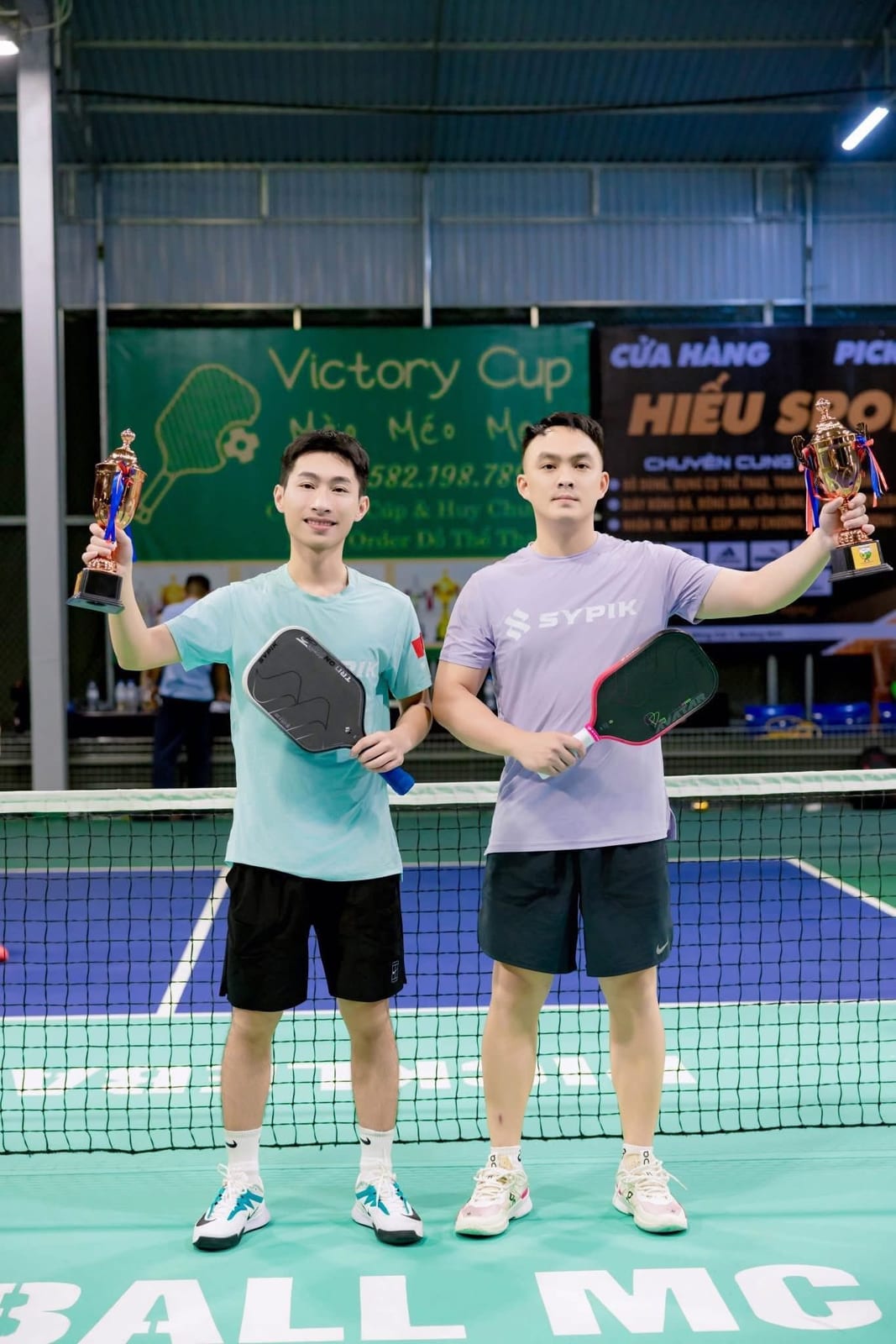 VĐV Sypik thi đấu pickleball
The pickleball court size of 20×44 feet is only the playing surface — the total footprint needed for safe, competitive play is significantly larger due to required clearance zones around the court perimeter.
Minimum footprint: The absolute minimum space to accommodate a single pickleball court with functional but tight clearance is 30 feet wide × 60 feet long (9.1m × 18.3m). This provides 5 feet of clearance beyond each baseline and 5 feet on each sideline — workable for casual recreational play but not ideal for competitive conditions or rapid lateral movement.
Preferred footprint: For safe competitive play, the ITPF and USAPickleball.org recommend a minimum total space of 34 feet wide × 64 feet long. This provides:
- 10 feet of clearance behind each baseline (recommended minimum for competitive play)
- 7 feet of clearance on each sideline (minimum 5 feet, preferred 7–10 feet)
Why clearance matters for safety: Players frequently run toward baselines to retrieve deep shots and toward sidelines to chase wide dinks. Insufficient clearance means players run directly into walls, fences, or neighboring courts — a leading cause of collision injuries in multi-court facilities. The 10-foot baseline buffer is especially critical in doubles, where switching, stacking, and transition movement regularly take players beyond the baseline.
Multi-court facility planning: For a 2-court facility side by side, plan for a minimum of 64 feet wide × 64 feet long, with at least 10 feet between courts and 10 feet on the outer edges. A 4-court facility requires approximately 120 feet × 64 feet minimum, factoring in inter-court buffers. Spectator areas and player bench zones should add a further 6–10 feet on at least one side of the facility.
Clearance for benches and equipment: Each court should have a dedicated equipment zone (at least 4 feet deep × 10 feet wide) for player bags, water stations, and coaching areas — positioned outside the primary clearance zone to prevent interference during play.
---
Indoor vs. Outdoor Court Specifications
Whether you're playing on an indoor pickleball court or an outdoor pickleball court, the playing surface dimensions are identical — 20 feet wide × 44 feet long — per ITPF regulations. However, the surrounding specifications, materials, and environmental factors differ significantly and directly affect gameplay quality.
Surface materials: Indoor courts most commonly use polyurethane sports flooring or cushioned acrylic systems installed over concrete. These provide consistent ball bounce and excellent traction in climate-controlled environments. Outdoor courts typically use acrylic coatings over asphalt or concrete — harder surfaces that produce slightly different ball speed and bounce characteristics.
Lighting requirements: Indoor facilities must meet minimum lighting standards for competitive play. ITPF and USA Pickleball guidelines call for a minimum of 15–16 foot-candles (approximately 160–170 lux) for recreational indoor play, and higher thresholds for sanctioned tournament conditions. Outdoor courts benefit from natural daylight but require proper artificial lighting for evening sessions.
Wind and outdoor considerations: Outdoor courts benefit significantly from windscreen installation along perimeter fencing. Wind dramatically affects the lightweight pickleball, particularly the outdoor ball variant, and can render crosscourt dinks and lobs nearly unplayable in strong conditions. North-south court orientation is strongly preferred for outdoor installations — this alignment minimizes direct sun exposure into players' eyes during morning and afternoon sessions.
Temperature and humidity effects: High temperatures on asphalt outdoor courts can elevate surface temperatures significantly, softening ball response and increasing ball speed. Humid conditions increase surface friction slightly. Indoor courts maintain more consistent ball behavior across seasons.
Ball selection: Outdoor balls (harder plastic, smaller holes) are designed for surface stability in wind and on harder outdoor surfaces. Indoor balls (softer, larger holes) perform better on cushioned indoor surfaces. Using the correct ball type for your court type significantly affects play quality and court surface longevity.
---
How to Mark Out Pickleball Courts on a Tennis Court
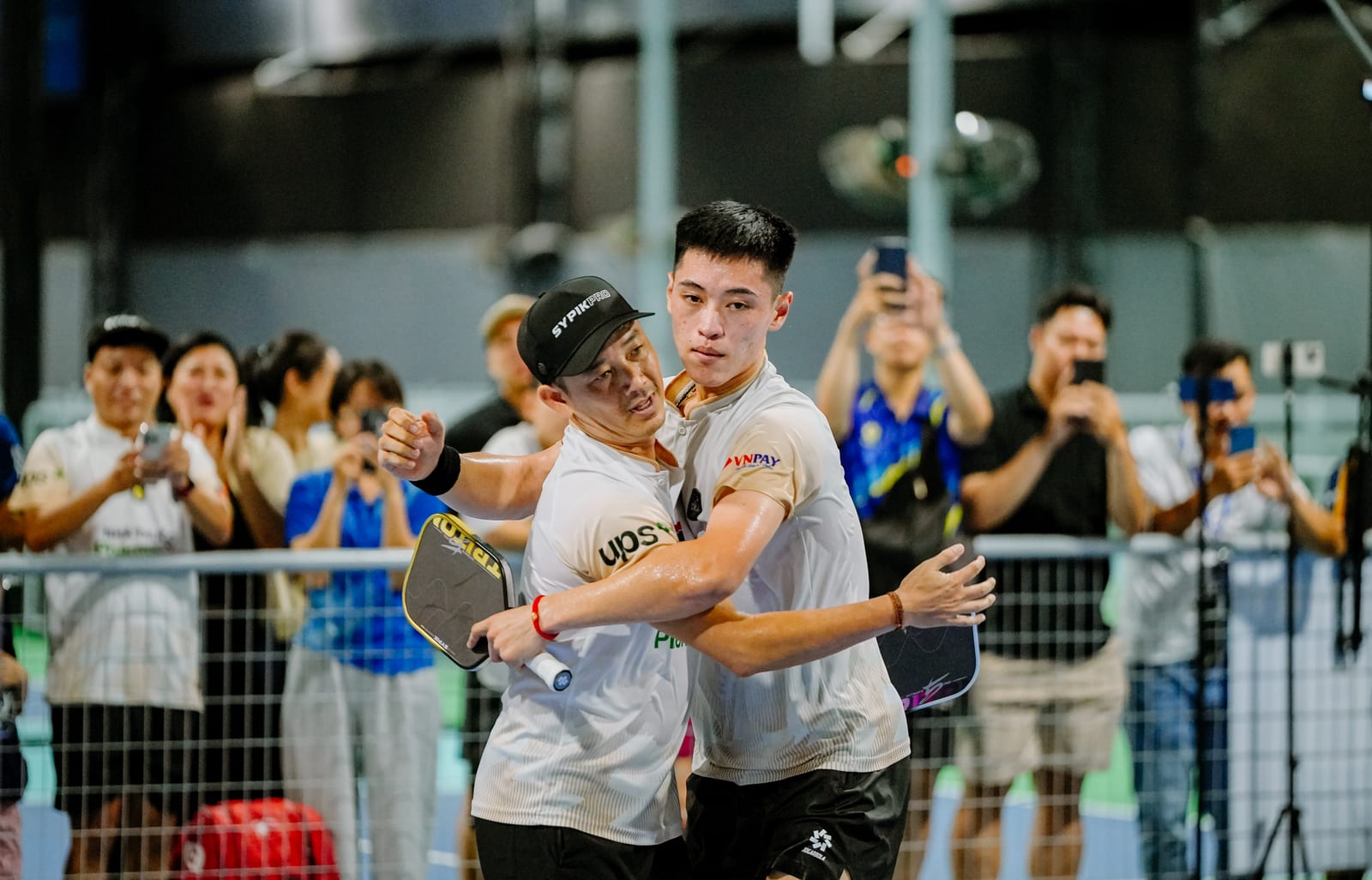 VĐV Sypik thi đấu pickleball
Converting a tennis court to pickleball courts is one of the most practical and cost-effective ways to expand pickleball access within existing facilities. A standard tennis court measures 78 feet long × 36 feet wide — large enough to accommodate multiple regulation pickleball courts.
Fitting 4 pickleball courts on 1 tennis court: The most efficient configuration places four pickleball courts within a single tennis court boundary. Each pickleball court occupies a 20×44-foot footprint; four courts can be arranged in a 2×2 grid within approximately 88×60 feet — which fits within the tennis court's extended run-out zone boundaries. This configuration requires temporary or permanent pickleball lines to be applied with careful measurement, as the courts will be oriented parallel to and perpendicular to the existing tennis lines. Clear color-coding is essential — use a distinct color (typically blue or yellow) for pickleball lines to prevent confusion with white tennis markings.
Fitting 2 courts on 1 tennis court (side-by-side): Two courts placed side by side across the width of the tennis court create the cleanest layout, each running 44 feet across the tennis court's length. This configuration uses the existing tennis net posts as reference points and allows 5+ feet of buffer between courts and at each sideline.
Single court placement: A single pickleball court can be centered on the tennis court using the existing net (adjusted in height) or a standalone portable net.
Temporary vs. permanent marking: Temporary pickleball lines are most commonly applied using 1.5–2-inch athletic court tape in blue, yellow, or green — colors that contrast clearly with the existing white tennis lines. Tape durability varies by surface type: acrylic tennis courts hold tape well for weeks, while rougher asphalt may require more frequent reapplication. Permanent pickleball line painting is the preferred long-term solution — applied using court-grade acrylic line paint in a non-white color, maintaining clear visual hierarchy between sport markings.
Avoiding line overlap: Plan your court placement diagram carefully before marking. The tennis service line sits 21 feet from the tennis net — dangerously close to pickleball kitchen lines (7 feet from the pickleball net). Overlapping these lines creates ambiguity for players. Offset court placement or bold color contrast helps maintain clarity.
---
Building a Backyard Pickleball Court: Step-by-Step Setup
A backyard pickleball court is a realistic investment for serious players who want consistent training access. Here is a professional-grade setup process from site selection through final maintenance protocol.
Step 1 — Site selection and drainage: Choose a flat area with adequate natural drainage away from the court surface. Standing water is the enemy of any sports surface. A minimum slope of 1% grade (1 inch per 8 feet) is recommended to direct water runoff. Avoid sites under heavy tree canopy — debris and root activity will damage any installed surface.
Step 2 — Leveling and base preparation: For permanent courts, excavate 4–6 inches and install a compacted gravel sub-base (4 inches) before pouring concrete. A standard concrete slab for a pickleball court should be 4 inches thick minimum, with reinforcement mesh or rebar grid for structural integrity. Allow concrete to cure fully — a minimum of 28 days before applying any surface coating.
Step 3 — Surface options: The three most practical surfaces for backyard courts are:
- Acrylic coating over concrete — most common, best ball response, available in cushioned or hard formulations
- Asphalt with acrylic top coat — cost-effective and durable, slightly harder underfoot
- Concrete sealant only — lowest cost but least forgiving on joints and knees
Step 4 — Measuring and staking the 20×44 layout: Use a measuring tape, chalk line, and corner stakes to precisely mark your 20×44 foot playing area. Verify all four corners are perfectly square using the 3-4-5 diagonal method (a diagonal corner-to-corner measurement of 48.3 feet confirms a true rectangle).
Step 5 — Line marking: Apply 2-inch-wide lines using athletic acrylic line paint or tape. Mark the kitchen lines 7 feet from the net on each side first, then the center service line, baselines, and sidelines in sequence.
Step 6 — Net installation: Install your net posts at exactly 22 feet from the center on each side (matching the sideline positions). Set net height to 36 inches at posts and verify 34 inches at center using a height gauge.
Cost estimates:
- DIY (materials only, concrete slab pre-existing): $2,000–$5,000
- Professional installation (full prep, concrete, surface, lines, net): $8,000–$25,000+ depending on surface quality and location
---
Court Surface Materials & Durability
 VĐV Sypik thi đấu pickleball
The surface material of a pickleball court has a direct impact on ball behavior, player safety, long-term maintenance costs, and competitive suitability. Here is a detailed breakdown of each major option.
Acrylic surfaces: The most widely used surface for competitive and recreational pickleball worldwide. Typically applied in 3–4mm thickness over a prepared concrete or asphalt base, acrylic coatings provide consistent ball bounce, predictable traction, and broad color availability for line contrast. Cushioned acrylic systems (with rubber-infused underlayers) reduce joint impact significantly — a meaningful factor for players logging daily training volume.
Asphalt base layer: Asphalt is a common and cost-effective base for outdoor courts, typically covered with two to three coats of acrylic resurfacer before line marking. Asphalt is slightly more prone to cracking in freeze-thaw climates than concrete but installs faster and at lower cost. Proper joint sealing is critical before acrylic application.
Concrete slab requirements: A structural concrete slab must be fully cured before any coating. Expansion joints must be properly filled and sealed. Concrete surfaces without acrylic top coating tend to produce inconsistent ball bounce near joint lines and offer less shock absorption for players.
Synthetic sports surfaces: Modular interlocking sports tiles (polypropylene-based) represent a newer technology increasingly used for temporary and semi-permanent installations. These offer excellent drainage, consistent traction, and easier DIY installation. Ball bounce characteristics differ slightly from acrylic but are tournament-approved by some governing bodies.
Weather impact: UV degradation affects all acrylic surfaces over time — resurfacing is typically required every 4–7 years for outdoor courts in high-UV environments. Freeze-thaw cycling is the most damaging factor for concrete and asphalt bases in temperate climates. Proper drainage engineering is the most effective preventive measure.
Slip resistance ratings: Competitive courts require a minimum slip resistance rating (typically 0.5 coefficient of friction wet and dry). Worn acrylic surfaces lose slip resistance over time and must be resurfaced before they compromise player safety.
---
Lighting Standards for Competitive & Recreational Play
Proper lighting is one of the most underinvested elements of pickleball court construction — and one of the most impactful for player experience and safety.
Minimum lighting levels: For recreational play, a minimum of 15 foot-candles (approximately 160 lux) of maintained illuminance across the court surface is required. This ensures players can track the ball comfortably through volleys and overhead play without strain.
Competitive tournament standards: For sanctioned tournaments — including those following ITPF certification requirements and events on the NGP Tour and PPA Tour Asia circuit — courts must achieve a minimum of 20 foot-candles (approximately 215 lux), with uniformity ratios ensuring no dark spots across the court surface. Higher-tier events may specify 30+ foot-candles for broadcast-quality lighting.
LED vs. traditional lighting: LED sports lighting has become the clear standard for new installations. LEDs deliver 30–50% greater energy efficiency than metal halide alternatives, provide instant full brightness without warm-up delay, and offer better color rendering (CRI 80+) that improves ball visibility. They also reduce maintenance costs significantly over a 10-year facility lifecycle.
Light pole placement: Poles should be positioned along the long axis (sidelines) of the court, set back from the sideline clearance zone by at least 4 feet. Mounting height of 20–25 feet is standard for single-court lighting. Avoid pole placement at baseline ends — this creates direct glare in the line of serve vision for one or both sides.
Glare reduction: Use full-cutoff luminaire housings and properly aimed fixtures to minimize horizontal glare at eye level. Anti-glare shields and proper aiming angles are especially important for evening tournament play where overhead serve accuracy is directly affected by glare.
Energy cost considerations: A typical 4-court outdoor facility using LED lighting (4 poles × 2 fixtures) will consume approximately 3–4 kWh per hour of full-court play — a manageable cost for most facilities compared to older HID lighting systems.
---
Common Court Setup Mistakes & How Champions Avoid Them
Even experienced court builders make critical errors that affect gameplay quality, player safety, and competitive fairness. Here are the most common mistakes and how they're prevented at the highest level.
Kitchen line placement error: The most frequent mistake is measuring the kitchen line at 6 feet from the net instead of the correct 7 feet. This seemingly small error shifts the strategic balance of the entire non-volley zone, making the kitchen effectively easier to exploit from the transition zone. Always measure from the center of the net post base, not the net tape.
Net height inconsistency: Competitive play requires verification at both the center (34 inches) and sidelines (36 inches). Many casual setups rely only on post height, resulting in a net that's too high or too low at center — affecting clearance on dinks and drive trajectories. Use a dedicated net height gauge at both points before every tournament session.
Inadequate clearance: Tight sideline or baseline clearance is among the top causes of player collision injuries in recreational facilities. The injury risk is not theoretical — at pace, players routinely move 2–4 feet beyond baselines and sidelines during competitive play.
Poor surface condition: A worn, cracked, or inconsistently painted surface disrupts ball bounce unpredictably, undermining shot-making consistency. Sypik Pro Champions Trương Vinh Hiển and Đỗ Minh Quân — who together won the Men's Doubles title at PPA Tour Asia in December 2025 — consistently note that surface quality is a primary factor in whether a player can execute soft-game shots with confidence. A true, consistent surface allows a paddle like the SYPIK TRITON 5 PRO ULTIMATE to perform as engineered, with repeatable ball response and precise placement.
Line markings too thick or faded: Lines wider than 2.5 inches create ambiguous "in or out" calls at high-speed play. Faded lines in critical areas — particularly the kitchen line — lead to contested calls that disrupt match flow. Repaint or retape lines annually for outdoor courts, or as needed for high-traffic indoor surfaces.
Explore the Sypik champions roster to see how tournament-level athletes approach court quality as part of their competitive preparation.
---
Official Pickleball Organizations & Court Standards
Multiple governing bodies establish and maintain pickleball court specifications globally. Understanding which organization applies to your region and competition level ensures full regulatory compliance.
ITPF (International Pickleball Federation): The primary international governing body for pickleball worldwide. The ITPF publishes the official court specifications — including the 20×44-foot playing area, 7-foot kitchen dimensions, and net height standards — that serve as the baseline for all internationally sanctioned tournaments, including those held across Asia, Europe, and the Americas. ITPF specifications are updated periodically to reflect evolving competitive standards.
USAPickleball.org: The national governing body for pickleball in the United States, and one of the most referenced standards globally given the sport's American origins. USAPickleball.org maintains detailed court construction guidelines aligned with ITPF specifications and provides official rulebooks updated annually. Their 2024–2026 rulebook revisions clarified several kitchen line interaction rules relevant to tournament officiating.
IPA (International Pickleball Association): The IPA provides court certification protocols for facilities seeking official accreditation for competitive events. IPA-certified courts undergo verification of surface quality, line accuracy, net specification, and clearance compliance.
PPA Tour and NGP Tour requirements: Professional circuits including the PPA Tour Asia and NGP Tour apply enhanced court standards — including lighting minimums, surface uniformity, and spectator clearance zones — above the baseline ITPF specification. Courts hosting these events must be pre-certified by designated officials.
Annual specification updates: Court builders and facility managers should review ITPF and USAPickleball.org specifications annually, as line width guidance, surface rating standards, and lighting requirements are subject to revision as the sport scales professionally.
---
FAQ: Quick Pickleball Court Dimension Answers
Q: What are the official dimensions of a pickleball court?
A standard regulation pickleball court measures 20 feet wide × 44 feet long (6.1m × 13.4m), providing a total playing surface area of 880 square feet. These dimensions are mandated by the ITPF (International Pickleball Federation) and apply to all competitive and recreational regulation play worldwide — from local club courts to PPA Tour Asia and NGP Tour events.
Q: What is the height of a pickleball net?
A pickleball net is set to 36 inches (91.4 cm) at the sideline posts and sags to 34 inches (86.4 cm) at the center of the court — 2 inches lower in the middle. This differential is by design and must be verified at both measurement points using a net height gauge before competitive play. Portable nets must also meet this specification.
Q: What is the kitchen in pickleball?
The "kitchen" is the non-volley zone (NVZ) — a 7-foot-deep zone extending from the net on each side of the court, spanning the full 20-foot court width. Players may not volley (strike the ball before it bounces) while standing in the kitchen or touching the kitchen line. This rule is the cornerstone of pickleball strategy, forcing players into soft-game exchanges (dinks and resets) rather than pure power play at the net.
Q: How far is the baseline from the net in pickleball?
The baseline sits exactly 22 feet from the net on each end of the court. This accounts for the 7-foot kitchen zone plus a 15-foot service/transition zone. All serves must be executed from behind the baseline using an underhand motion.
Q: Can you fit multiple pickleball courts on a tennis court?
Yes. A standard tennis court (78 feet long × 36 feet wide) can accommodate up to 4 regulation pickleball courts arranged in a 2×2 configuration within the full facility boundary including run-out zones. Two courts can be placed side by side cleanly within the tennis court's width. Use colored tape or paint in a non-white color (blue or yellow) to distinguish pickleball lines from existing white tennis court markings.
Q: What is the minimum space needed to build a pickleball court?
The absolute minimum total footprint is 30 feet wide × 60 feet long (9.1m × 18.3m), which includes the 20×44-foot playing surface plus 5 feet of minimal clearance on all sides. The preferred and recommended footprint for safe competitive play is 34 feet wide × 64 feet long, providing 10-foot clearance behind baselines and approximately 7 feet on each sideline.
Q: What surface is best for pickleball courts?
Acrylic coating over asphalt is the most widely used surface for competitive outdoor pickleball, offering a reliable balance of ball response, traction, durability, and cost. Concrete with an acrylic top coat is preferred for new permanent installations due to greater structural stability. Synthetic interlocking sports tiles are gaining traction for temporary and backyard installations. Indoor courts most commonly use cushioned acrylic or polyurethane sports flooring over concrete for consistent ball bounce and joint protection.
Q: Do indoor and outdoor courts have different dimensions?
No — both indoor and outdoor pickleball courts follow the identical 20 × 44 ft (6.1m × 13.4m) ITPF specification. The differences are limited to surface material, lighting requirements, and environmental factors (wind, sun angle, humidity, temperature). Ball selection differs by court type — outdoor balls (harder, smaller holes) for outdoor play; indoor balls (softer, larger holes) for indoor surfaces.
Q: How much does it cost to build a pickleball court?
DIY backyard court construction (assuming a concrete slab is already in place) typically costs $2,000–$5,000 for surface coating, line marking, and a portable net system. A full professional installation — including site preparation, concrete slab, acrylic surfacing, line painting, and permanent net posts — ranges from $8,000 to $25,000+ depending on surface specification, location, and site complexity. Multi-court facility builds scale accordingly with shared infrastructure savings per court.
Q: What lighting is needed for pickleball courts?
Recreational play requires a minimum of 15 foot-candles (approximately 160 lux) of maintained illuminance across the court surface. Competitive tournament play, including events certified by the ITPF and circuits such as the PPA Tour Asia and NGP Tour, requires a minimum of 20 foot-candles (approximately 215 lux). LED lighting is the recommended technology for all new installations due to efficiency, longevity, and superior color rendering for ball tracking.
---
Final Note: Play on the Right Surface, With the Right Equipment
Every dimension, clearance zone, and surface specification in this guide exists for one reason: to create a consistent, fair, and safe environment where the best play wins. Court quality directly enables equipment performance — including the SYPIK TRITON 5 PRO ULTIMATE, engineered with Raw Carbon T700 fiber and a PolyCore honeycomb structure to deliver precise ball response on regulation surfaces.
If you're ready to build your setup or upgrade your game, explore the full range of Sypik paddles trusted by Champions across Asia's top competitive circuits.
Related Articles

Lưới Pickleball: Hướng Dẫn Chọn & Tiêu Chuẩn Quốc Tế 2026
Hướng dẫn chi tiết lưới pickleball chuẩn ITPF: kích thước, chất liệu, cách lắp đặt và bảo trì. Dùng cho sân thi đấu, giải trí — đánh giá từ Sypik.

Túi Pickleball: Hướng Dẫn Chọn & So Sánh Gear Pro 2025
Hướng dẫn chi tiết cách chọn túi pickleball phù hợp: kích thước, chất liệu, brand top. Đánh giá từ Champions Sypik kèm bảo hành NFC 6 tháng.

Giải Pickleball 2026: Hướng dẫn Toàn Diện Các Giải Đấu Lớn Thế Giới & Việt Nam
Hướng dẫn chi tiết giải pickleball lớn nhất 2026: từ US Open, APP Tour, PPA đến giải Pickleball Việt Nam. Lịch thi đấu, quy tắc & cách tham gia.

Pickleball Ball: Hướng dẫn chọn bóng phù hợp cho mọi tay vợt
Tìm hiểu chi tiết về bóng pickleball: tiêu chuẩn ITPF, sự khác biệt trong nhà vs ngoài trời, cách chọn bóng phù hợp. Lỏng hơn tennis, điều khiển dễ hơn.